By Emily Schlickman
I walk slowly through a small valley in Napa, California where a dense stand of oaks rises from a field of golden grasses. A place that has not burned in more than a century. Underfoot, the forest floor is thick with twigs and leaves. In the language of firefighting, this is called fuel. But it is also what carries fire forward, what gives fire its body and direction.
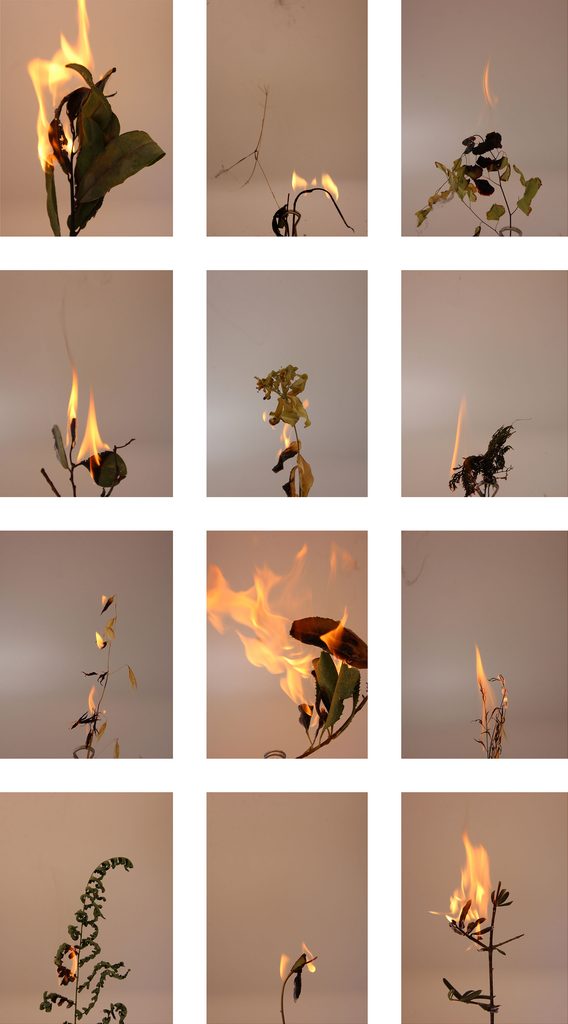
I bend to gather what would be classified as one-hour fuels, the lightest and quickest to ignite. The flashy fuels. They fit easily in my hands: dry grass, brittle leaves, broken stems. Like the wild oats that shimmer across the hillside.
Wild oats are not native here. They arrived centuries ago as fodder for animals brought across oceans. They displaced deep-rooted native perennials that once stayed green long into summer. Now, the wild oats grow fast, dry early, and burn easily. Colonization reshaped this land not only through fences and property lines, but through how fire is carried across it.
Long before fire suppression became policy, Indigenous people across California used fire as a form of care. They burned to open meadows, grow food and medicines, clear travel routes, shape habitats, and prevent the buildup of dense understory plants that lead to catastrophic fire. Fire was not an emergency. It was a tool, a relative, a seasonal rhythm. The grasses, shrubs, and trees evolved alongside that relationship. They learned how to hold fire without losing themselves to it, how to pass it gently.
I walk farther upslope to where the native toyon grows in thick, dark tangles. Its leaves stay green when everything else pales. In winter, its red berries draw birds into the heart of the thicket. Even now, in the heat, it holds moisture longer than the grasses around it. After fire, it will send new shoots from its base and help hold the hill in place when the rains return.
Deeper still, wandering under taller trees, the scent changes. Sharp and clean. California bay. I crush a leaf between my fingers, and the smell rises immediately, medicinal and bright. For generations, bay has been used to ease fevers, clear headaches, scent ceremonies, and protect homes. Its smoke was once carried deliberately through villages and gathering places.
In modern wildfire maps and risk models, plants are reduced to a single role. Fuel. A word that defines them only by what they will become in the presence of flame. It is a useful word. It saves lives. It helps crews predict how fire moves across slope and through wind. But it also narrows the world. It teaches us to see the living landscape as future ash, a reduction that feels incomplete. These plants are not just burnable material. They are food for birds, medicine for bodies, shelter for soil, inheritance from distant hands. They do not simply wait to be consumed.
Fire does not arrive here as an intruder. It is already part of how this place breathes. What has changed is the rhythm. A century of suppression has pressed pause on a process that once moved more steadily and more gently. Fire has returned anyway, but more forcefully. The land remembers even when we pretend it does not. The plants still know how to carry it. We are the ones who have forgotten how to guide it.
The question is not whether fire will return. It always does. The question is how we choose to meet it. Whether we continue to see the land and fire only through the narrow lenses of hazard and catastrophe, or whether we widen our vision to hold Indigenous knowledge, ecological process, medicine, memory, and regeneration at the same time.
When fire comes again to this valley, each of these plants will burn differently. The oats will flash and vanish. The toyon will blacken and return. The bay will carry its medicine into smoke. Together, they form a single fire, but their stories do not dissolve into one. Fire is not a uniform thing moving across a blank surface. It is handed forward, received, resisted, slowed, lifted, and released again by the plants themselves.